
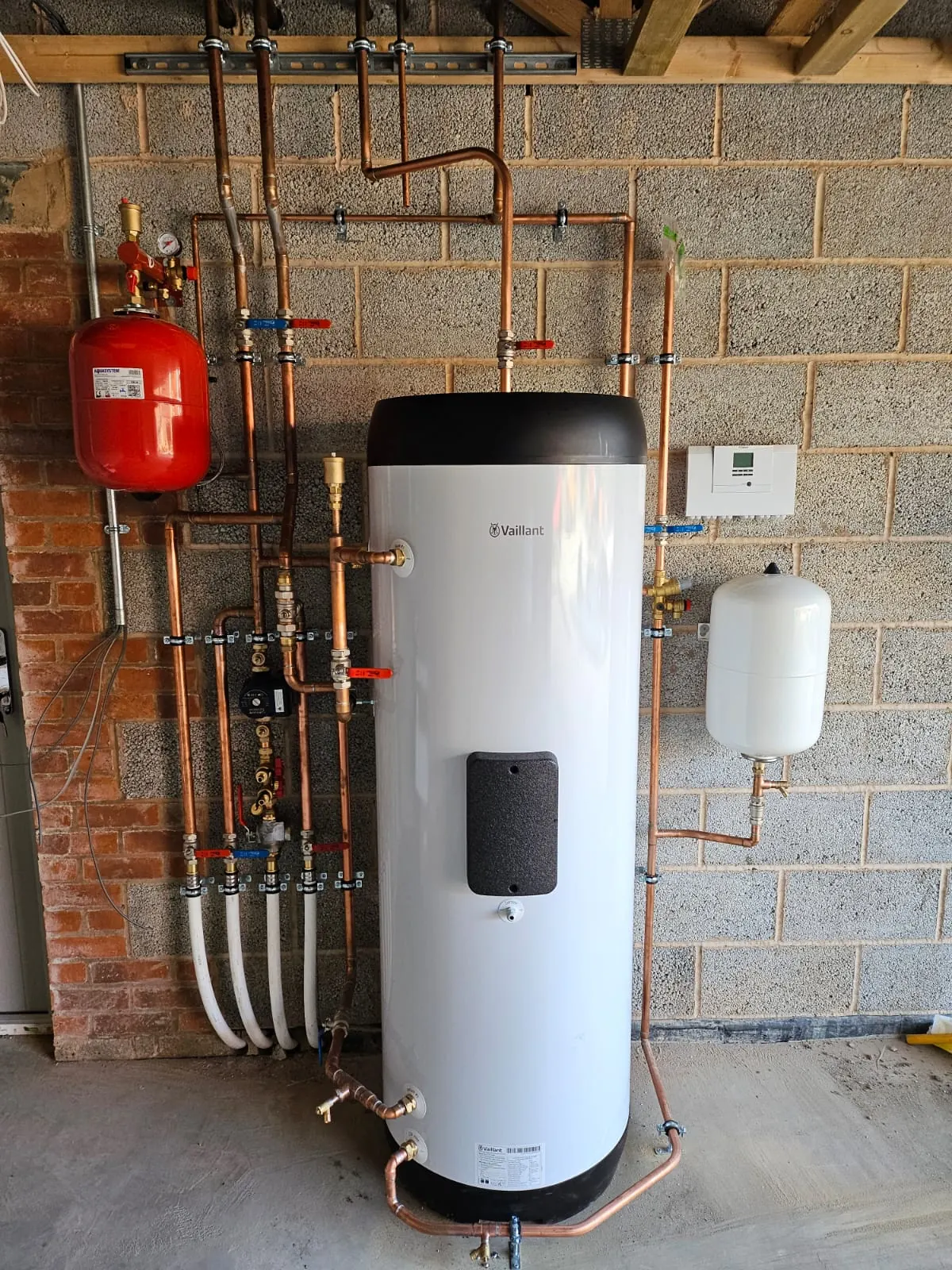
Key takeaways
- Open-system design is about letting the heat pump serve the emitters with fewer unnecessary barriers.
- Buffers and separation can be useful, but they should solve a specific design issue.
- The best layout depends on flow rate, emitters, controls and system volume.
Open system design is about the water circuit
Open system heat pump design means the heating circuit is planned so the heat pump can move water through the emitters with as little unnecessary separation as possible. The idea is not to remove every component. The idea is to avoid adding parts that make the system less direct without a clear reason.
This article is for people who have heard AquaTherma talk about high-flow, low-temperature open systems and want to know what that means in practice. The short answer: the pipework, emitters, pumps, controls and commissioning should help the heat pump run steadily at low temperatures.
Why hydraulic layout matters
A heat pump does not only need a power supply and an outdoor location. It needs a water circuit that can carry enough heat into the building. If the circuit restricts flow, mixes temperatures poorly or creates control conflict, the heat pump can run hotter, cycle more often or deliver less comfort than expected.
Good hydraulic design checks flow rate, pressure loss, emitter output, system volume, protection devices and control logic before equipment is ordered.
- Can the heat pump achieve the required flow rate?
- Can emitters deliver enough heat at the design temperature?
- Is there enough system volume for stable operation?
- Are pumps working with each other rather than against each other?
- Do controls allow steady heat rather than short bursts?
When buffers and separation can help
Buffers, low loss headers and hydraulic separation are not bad parts. They can help where a system has multiple circuits, low system volume, awkward zoning or a need to protect flow through the heat pump. The problem is using them as a default answer without checking whether they add losses or complexity.
A good designer should be able to explain why a buffer is present, how it is piped and what it protects. If the reason is only that every system gets one, ask for more detail.
| Component | Can help when | Can hurt when |
|---|---|---|
| Buffer cylinder | System volume or flow stability is genuinely needed | It adds temperature loss without solving a problem |
| Extra pump | A separate circuit needs controlled flow | It fights the heat pump pump or adds wasted electricity |
| Mixing valve | A high temperature circuit must be protected | It is added to UFH that could run directly at heat pump temperature |
| Zone valves | Spaces need separate control | Too many zones force short cycling |
Open does not mean uncontrolled
Open-system design still needs control. Weather compensation, room influence, cylinder schedules, UFH actuators, safety limits and frost protection all need to be set correctly. Open simply means the water circuit is kept as direct as the design allows.
In a well-planned system, simplicity and control work together. The heat pump sees a stable load, the emitters receive useful flow and the homeowner gets predictable comfort.
What to ask your designer
You do not need to become a heating engineer to ask good questions. Ask for the design flow temperature, the hydraulic layout, the reason for any buffer, and how each zone or circuit will be controlled.
The answer should be clear enough that you can understand the main choices. If the design is genuinely complex, the explanation should be clearer, not more hidden.
- What flow temperature is the design based on?
- What flow rate does the heat pump need?
- Is there a buffer or low loss header? Why?
- How are UFH and radiators controlled?
- How will the system be commissioned and checked?
Frequently asked questions
Is an open heat pump system always better?
No. Open-system design is a useful principle, not a rule for every property. Some systems need buffers or separation. The key is that each component should have a clear design reason.
Does open-system design mean no buffer cylinder?
Not always. It means a buffer should not be added by habit. If the design needs system volume, flow protection or circuit separation, a buffer can still be the right choice.
Can open-system design work with underfloor heating?
Yes, UFH can suit open low-temperature design very well when pipe spacing, manifold layout, controls and flow rates are planned around the heat pump.